


Table of Contents
- Key Points
- What Are the Three Types of Solar Panels and What Are They Made of?
- What Does Each Solar Panel Look Like?
- Comparing the Three Types of Solar Panels
- Other Factors to Consider for Your Solar Panels
- Applications and Installation for Each Type of Solar Panel
- Which Type of Solar Panel Is Best?
- Best Solar Panels on the Market by Brand
- Contact 8MSolar
Solar panel installation offers many advantages for your home, such as lower electricity bills, energy independence and clean energy. When you are considering adding solar panels, you have to think about different factors such as energy efficiency, appearance and costs. These are essential factors and will play a large part in your decision. One of the most important aspects of buying solar panels is the type of solar panels you choose to buy.
Ultimately, your specific situation and what you wish to achieve will determine which solar panel is right for you. This helpful guide will outline the different types of solar panels, their benefits and how to pick the best solar panels for you.
Key Points
- The three types of solar panels are Monocrystalline (efficient, expensive), Polycrystalline (budget-friendly), and Thin-Film (versatile, shortest lifespan).
- Monocrystalline panels are most efficient, thin-film are least expensive, with polycrystalline panels balancing both aspects.
- Lifespans of panels vary by type (monocrystalline longest, thin-film shortest). Other factors include temperature coefficient, fire and hail resistance.
- Selection depends on location and space. Polycrystalline for large residential roofs, monocrystalline for small spaces, thin-film for commercial use.
- The top solar brands include Q Cells, Solaria, and REC Group for their quality, warranties, and support.
- 8MSolar offers expertise in installation, quality products, and tailored solutions for both residential and commercial customers.
What Are the Three Types of Solar Panels and What Are They Made of?
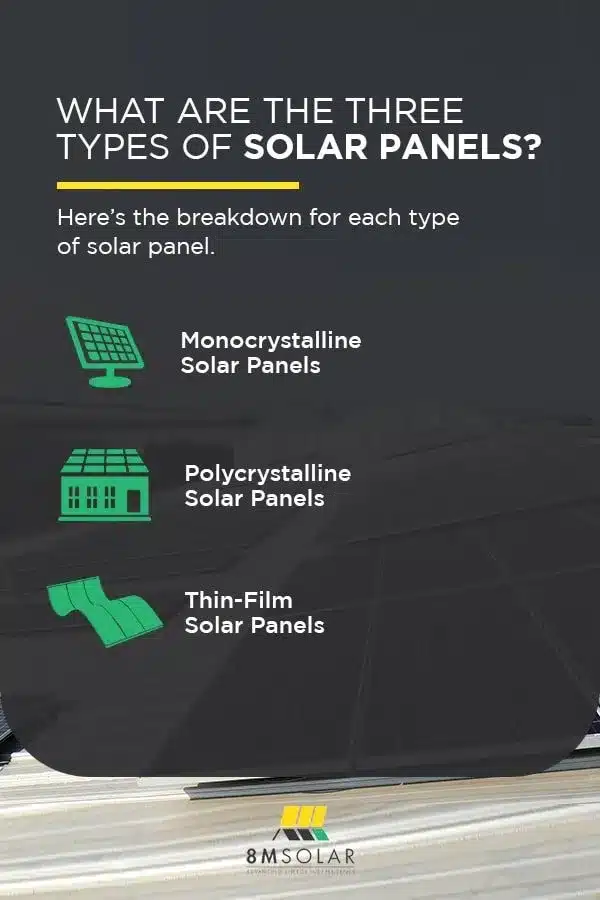
The three different types of solar panels are thin-film, polycrystalline and monocrystalline solar panels. Each of these types of solar cells is made in a unique way and has a different aesthetic appearance. Here is the breakdown for each type of solar panel.
1. Monocrystalline Solar Panels

Monocrystalline solar panels are known for their high efficiency and sleek design, making them a popular choice for homeowners and businesses. Made from pure silicon, these panels are the most developed type of solar technology, offering excellent performance in a compact design.
How Are They Made?
Monocrystalline panels are created using what’s known as the Czochralski method:
- Molten Silicon: A pure silicon crystal is placed in a vat of molten silicon.
- Crystal Formation: The crystal is carefully pulled out, forming a solid shell called an ingot.
- Thin Wafers: The ingot is sliced into thin silicon wafers, which are turned into solar cells.
- Panel Assembly: The cells are arranged into a solar panel, leaving small gaps between them.
The cells are black due to the pure silicon, while the frames and back sheets come in a variety of colors to match different styles.
Why Choose Monocrystalline Panels?
- High Efficiency: These panels convert more sunlight into electricity, making them ideal for homes with limited roof space.
- Durability: They last longer and often come with extensive warranties, like 8MSolar’s 25-year guarantees.
- Sleek Appearance: Their black color and customizable frames make them visually appealing.
Things to Consider
While monocrystalline panels are the most efficient, they’re also the most expensive. Their long-term energy savings and superior performance make them a worthwhile investment for those seeking maximum output and reliability.
Monocrystalline panels offer a blend of performance and style, making them a leading choice for modern solar installations.
2. Polycrystalline Solar Panels

Polycrystalline solar panels are becoming more popular due to their affordability and solid performance. While they also use silicon-like monocrystalline panels, their manufacturing process makes them more budget-friendly, making them an excellent option for cost-conscious buyers.
How Are They Made?
Polycrystalline panels are created using a more modern method:
- Silicon Fragments: Instead of a single crystal, silicon fragments are melted together in a vat of molten silicon.
- Cooling Process: The melted silicon is left to cool in its mold, forming a solid block.
- Wafers to Panels: The cooled silicon block is sliced into thin wafers, which are then arranged into solar panels.
Key Features
- Color and Appearance: The fragmented silicon gives polycrystalline panels a distinctive blue hue, unlike the black appearance of monocrystalline panels.
- Shape: Panels are square with no gaps between cells, creating a uniform look.
- Frames: Frames are typically silver, adding to their modern appearance.
Why Choose Polycrystalline Panels?
- Cost-Effective: Their manufacturing process reduces production costs, making them a more affordable solar solution.
- Good Efficiency: While slightly less efficient than monocrystalline panels, they provide reliable energy output for a variety of applications.
- Eco-Friendly Manufacturing: Using fragments of a silicon crystal reduces waste during production.
Things to Consider
Polycrystalline panels are a great choice for those balancing performance and budget. They may require slightly more space than monocrystalline panels to achieve the same energy output, but they offer a practical and cost-effective solution for many solar energy needs.
With their affordability and reliable energy production, polycrystalline solar panels are an excellent choice for homes and businesses seeking a greener future without breaking the bank.
3. Thin-Film Solar Panels

Thin-film solar panels are the newest and most versatile type of solar technology. Unlike traditional panels that rely solely on silicon, these panels can be made from a variety of materials, including:
- Copper Indium Gallium Selenide (CIGS)
- Cadmium Telluride (CdTe)
- Amorphous Silicon (a-Si)
How Are They Made?
The manufacturing process involves layering the chosen material between thin sheets of conductive material, with a protective top layer of glass. For example, a-Si panels use non-crystalline silicon covered with glass to shield the cells.
Key Features
- Ultra-Thin Design: Thin-film panels are approximately 350 times thinner than traditional silicon-based panels, giving them a sleek, lightweight appearance.
- Versatile Appearance: Panel colors vary based on the materials used but are typically black or blue. While the frames can resemble those of monocrystalline and polycrystalline panels, the thin-film cells stand out due to their slim profile.
Why Choose Thin-Film Panels?
- Flexibility: Ideal for unconventional installations, thin-film panels can adapt to curved or uneven surfaces, such as roofs, vehicles, or portable setups.
- Lightweight: Their reduced thickness makes them easier to transport and install, especially for large-scale projects.
- Aesthetic Options: With their sleek appearance, these panels blend well with modern architectural designs.
Considerations for Thin-Film Panels
While their flexibility and design are unmatched, thin-film panels typically have lower efficiency and a shorter lifespan compared to silicon-based options. However, their affordability and adaptability make them an excellent choice for specialized applications.
Whether you’re powering a portable setup, integrating solar into a vehicle, or designing a curved installation, thin-film solar panels offer a modern and innovative energy solution.
What Does Each Solar Panel Look Like?
Monocrystalline panels are typically black due to how light interacts with the silicon crystal. Although you can find different colors for the back panels, they will typically be white, silver or black with either silver or black frames.
Polycrystalline panels appear blue as the light reflects from the silicon fragments. You can also find different colors for the back sheets and frames, but you will most often see silver or white back sheets with silver frames.
Thin-film panels have a different aesthetic than the previous two types. These panels are slimmer and can create a different look for your property compared to the other two. Depending on the panels’ materials, thin-film systems will likely appear in black or blue hues.
Comparing the Three Types of Solar Panels
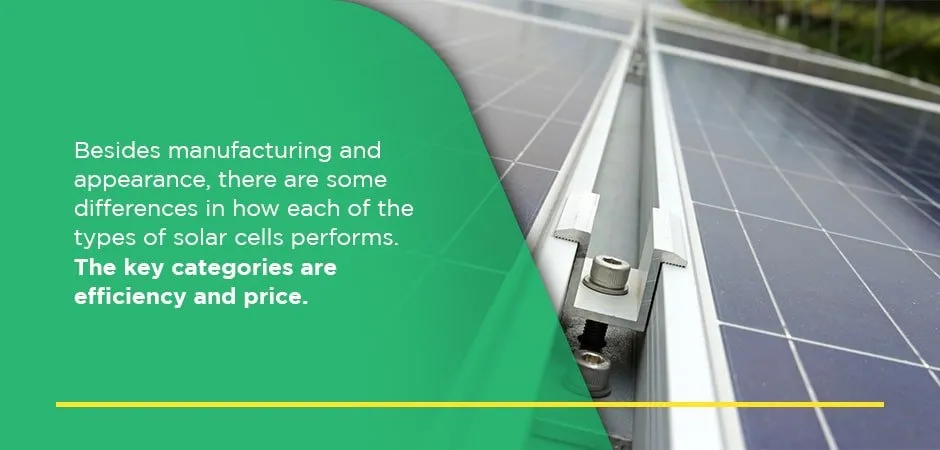
Besides manufacturing and appearance, there are some differences in how each of the types of solar cells performs. The key categories are efficiency and price. Here is how each type of solar panel performs in efficiency and affordability as well as other factors to consider.
Efficiency
Efficiency is how much energy the different solar panel types can produce from the amount of sunlight it receives. Essentially, efficiency determines how much power a solar panel can produce. There are many things you can do to increase your solar panel efficiency, but some solar panels are designed to be more efficient from the beginning. The most efficient solar panel is the monocrystalline solar panel.
Monocrystalline solar panels can reach over 20% efficiency. These panels have a high capacity, with most capable of providing more than 300 watts and some exceeding 400 watts. On the other hand, polycrystalline panels can usually only reach 13%-16% efficiency. This gap between the two panels may be closing in the future as technology improves to make polycrystalline panels more efficient.
Thin-film usually offers efficiency hovering between 7% and 18%. The power capacity of a thin-film panel can vary though because there is no standard size, and some models could produce more power than others.
Cost
Price can make or break a solar decision, and the types of solar cells you choose are one of the factors that affect the price the most. The cheapest solar panels are thin-film panels because they can be manufactured at the lowest cost. The CdTe are the cheapest solar panels on the market, but the CIGS can be more expensive.
Thin-film frames are usually lighter, so you can often save on installation costs. On the other hand, monocrystalline is the most expensive solar panel option right now. Manufacturing pure silicon can be expensive, and the panels and frames are heavy, leading to higher installation costs.
Polycrystalline panels were developed to reduce the cost of solar panels, and they are usually more affordable than monocrystalline. But this gap between monocrystalline and polycrystalline panels may close as innovators discover more efficient ways to manufacture monocrystalline solar cells. Keep in mind that on top of solar panel costs, there are often installation costs and monitoring costs as well.
Pros and Cons of Each Type of Solar Panel
| Solar Panel Type | Advantages | Disadvantages |
| Monocrystalline | High efficiency and performance | Higher costs |
| Polycrystalline | Lower costs | Lower efficiency and performance |
| Thin-film | Portable and flexible | Lower efficiency and performance |
Other Factors to Consider for Your Solar Panels
Besides cost and efficiency, there are several other factors to consider when choosing solar panels. Evaluating the life span, temperature coefficient, fire and hail resistance and other considerations will help you determine the best solar panels for your home or business.
Life Span
How long your panels will last will be an essential deciding factor. You want to ensure the panels you choose will stay up and running for as long as possible so you can get the most use out of them.
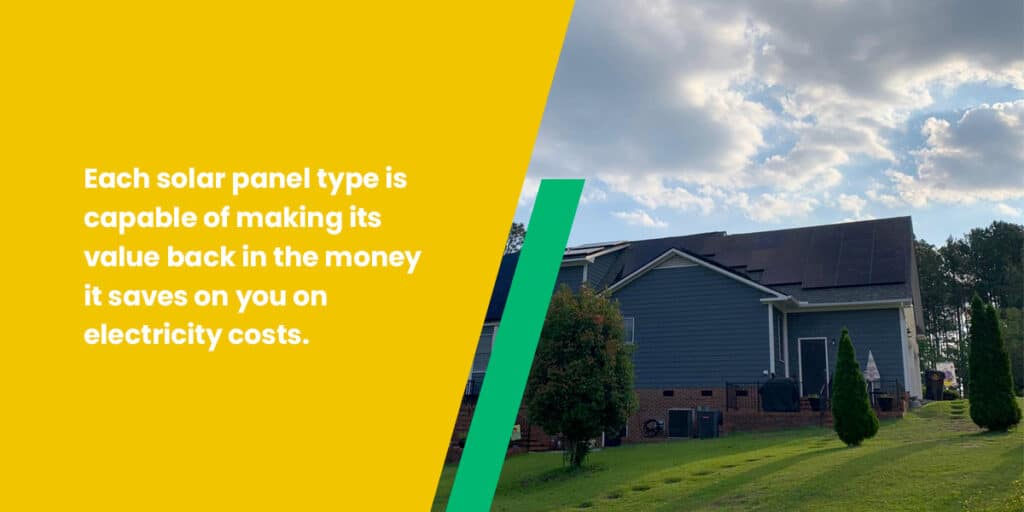
Monocrystalline panels typically last between 25 and 40 years, while the polycrystalline life span ranges from 20 to 35 years. Thin-film panels offer the shortest life span, typically lasting between 10 and 20 years. The upfront cost of some panels could counteract your long-term commitment and require you to invest more later. However, each solar panel type is capable of making its value back in the money it saves on you on electricity costs.
Temperature Coefficient
One factor is the temperature coefficient. Monocrystalline and polycrystalline solar panels typically have a temperature coefficient of around -0.3% / °C to -0.5% / °C. Thin-film panels have coefficients closer to -0.2% / °C.
What this means is that as the temperature rises, certain types of solar panels will produce more power than others. This is especially important to consider in an area like North Carolina, where the temperature high can be significant.
Fire Resistance, Hail Resistance and Hurricane Rating
Weather conditions are another important aspect to consider when picking the right solar panel system for your home. One important factor to consider is fire rating, which can vary based on the type of roof you have and the type of panel you choose.
- Class A: Class A-rated materials minimize flames to 6 feet and effectively stop fire spread. Many urban areas with wildfire or fire severity risks require this rating.
- Class B: Class B-rated materials are effective at protecting buildings from moderate fires and can prevent flames from exceeding 8 feet.
- Class C: These materials will only protect against light fire exposures and can allow flames to reach as high as 13 feet.
Class A materials will be the best options for protecting your home or business, especially in areas where fires are common or likely to occur.
Fire is not the only natural disaster that can strike your roof, so you will also want to consider hail ratings. Most monocrystalline and polycrystalline panels can withstand 25mm falling at approximately 50 miles per hour, but the exact rating can vary and can affect the life span of your solar system.
Although there is no classification for hurricane rating systems, there are new specifications to safeguard your property from severe weather. Look for panels with the following:
- The highest rating for wind and snow loading in the back and front
- Fasteners with true locking capabilities
- Through-bolting modules rather than clamping fasteners
- 3-frame rail systems for support against twisting and improved rigidity
- Fencing around the system to dampen wind forces
UL and IEC Listings and Other Considerations
You also may want to consider finding heterojunction solar cell technology (HJT) for your system that combines monocrystalline silicon wafers with amorphous silicon. HJT has peak efficiency with the lowest temperature coefficient and no Light Induced Degradation (LID). Finally, you will want to consider LID because degradation of efficiency can affect the amount of energy you are able to produce.
All of these various factors are considered by our engineers when designing and recommending a solar PV system. We look at the overall system life cycle and efficiency not just in ideal scenarios but in all conditions that your solar PV system will be subjected to.
It is a great idea to have a basic understanding of how solar panels work, but we understand it can be overwhelming to choose the proper type of solar panels. Our solar experts at 8MSolar are available to assess your needs and help you make the best decision for your unique needs.
Applications and Installation for Each Type of Solar Panel
Now that you understand some of the defining characteristics of each solar panel, their applications can help you evaluate which one is right for you. You will find the best type of solar panel when you consider the installation locations and the panels’ purpose. For residential properties with a large roof space or property, the best choice of panels may be polycrystalline. These panels are the most affordable for large spaces and will provide enough efficiency and power. For residential properties with smaller spaces, monocrystalline solar panels may be the best choice. These panels work well for those who want to maximize their energy bills in a small space.
Monocrystalline solar panels and polycrystalline solar panels are excellent choices for homes and similar property buildings. Homeowners almost never utilize thin-film solar panels because they are lower in efficiency. Instead, business owners and commercial buildings use thin-film solar panels when they cannot handle the additional weight of traditional panels. Although thin-film is less efficient than the other panel options, commercial buildings have more roof space to cover the surface with panels.
Which Type of Solar Panel Is Best?
Looking through all the various types of solar panels and understanding their unique characteristics will help you narrow down your decision. Still, the best solar panel for you will likely be based on your specific situation — make sure you are taking a look at what you need most so you can choose the best option for you.
Consider some of the core factors involved in the decisions like function, size and cost:
- Function: Consider the main reason you are looking to purchase solar panels. You could be looking for savings on your energy bill or trying to decrease your energy footprint. Figuring out your primary reason for switching to solar can help guide you toward the right choice of solar panels for you.
- Size: Take a look at the surface area and the number of appliances you will want to power. A relatively small, simple home may require a different kind of solar panel than a sprawling house with more extensive amenities.
- Cost: One of the most significant factors you will want to consider when it comes to choosing the right solar panels for you is your budget. While you can still deviate a bit from a certain number, going in with a price range in mind will help keep you on track and allow you to choose the best solar panel for you.
Make sure you are keeping these important characteristics in mind as you shop for solar panels. Although understanding all of the various differences between types and figuring out what you need can be helpful in the process, you may still want some extra help to choose the right product. Be sure to seek out professionals in the industry who can help you find the best product for you.